


Introduction
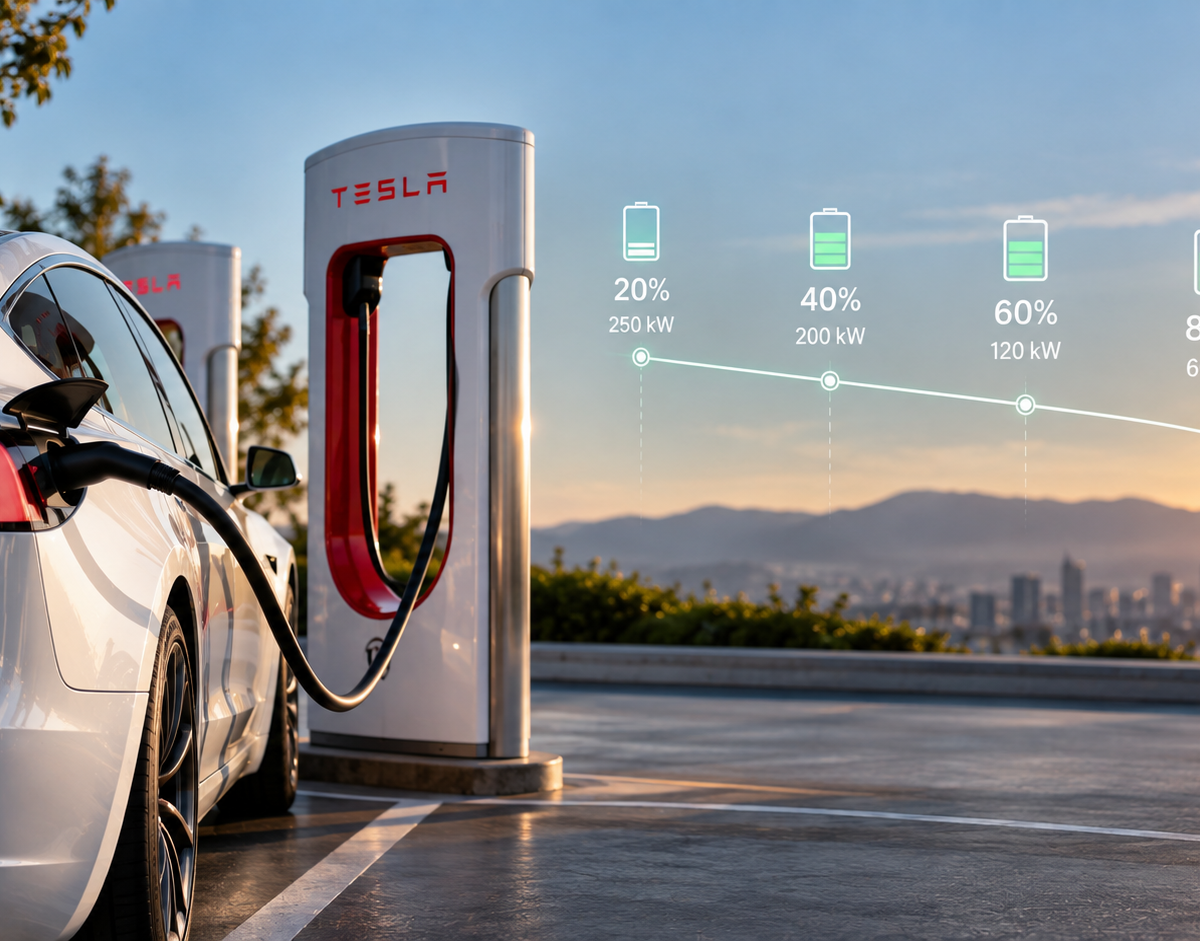
Your Tesla is charging quickly, the battery percentage is climbing, and then you cross 80%. Suddenly, those last few percentage points seem to take much longer.
In many cases, that slowdown is normal. As a lithium-ion battery approaches a high state of charge, the vehicle’s battery-management system reduces charging power. The goal is to carefully control cell voltage and heat rather than continue pushing energy into an increasingly full battery at the highest possible rate.
Understanding why a Tesla charges slower after 80% can help owners plan charging stops more efficiently—especially on road trips where an extra 15 or 20 minutes at a charger can feel considerably longer than it sounds.
What’s Happening?
EV batteries generally cannot accept maximum charging power throughout an entire charging session.
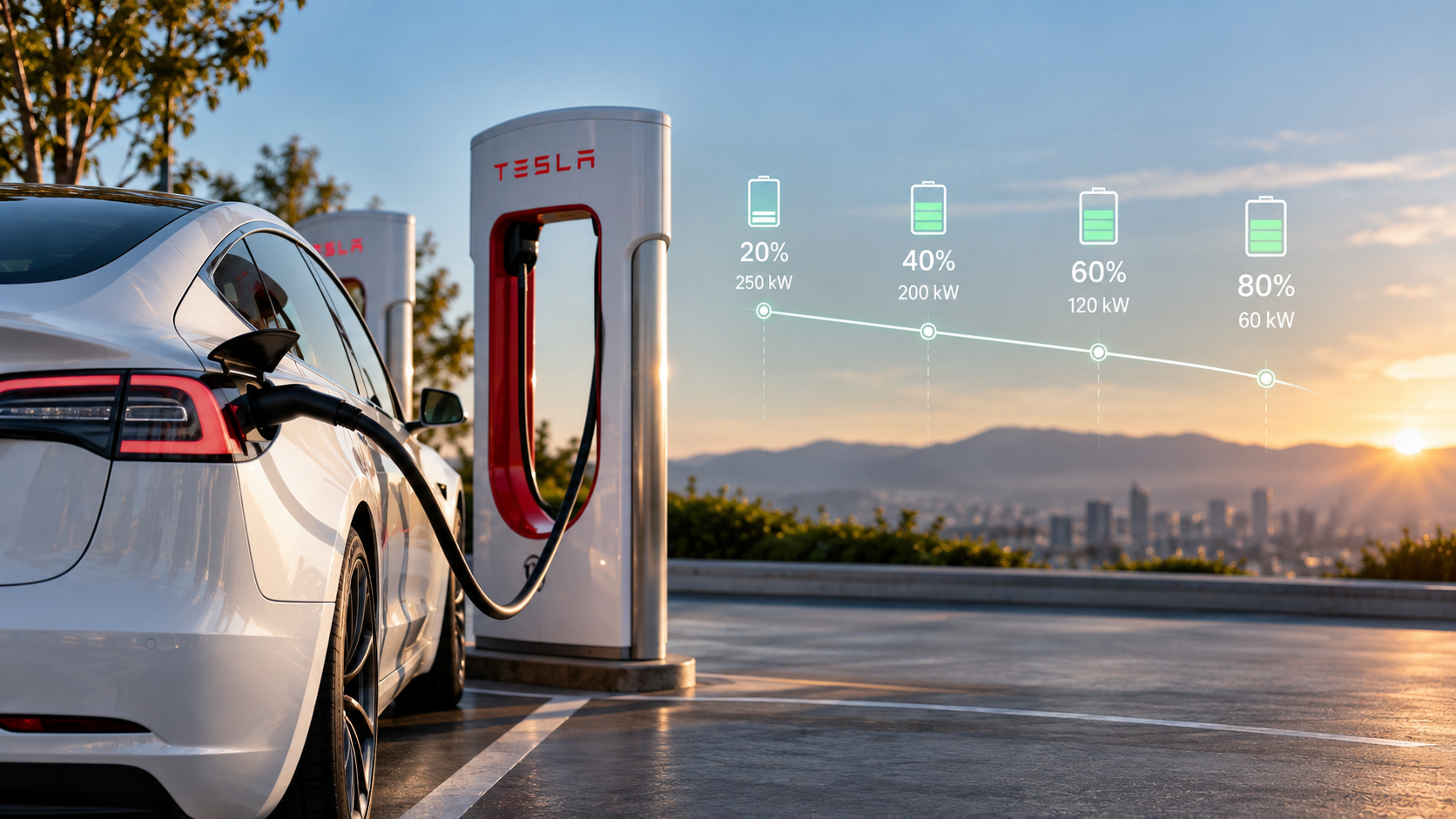
Instead, charging power changes as the battery fills. This behavior is commonly described as the charging curve.
During the faster portion of charging, the battery can accept relatively high current. As its state of charge increases, however, the charging system must become more conservative.
The supplied source material highlights several reasons:
- Cell voltage rises as the battery fills.
- Heat and internal resistance become increasingly important.
- Charging current is reduced as the battery approaches full.
- The battery-management system controls charging to protect the cells.
- The effect is particularly noticeable when using high-power DC fast charging such as Supercharging.
This reduction in power is known as charging taper.
Importantly, 80% isn’t a magical switch where every Tesla instantly changes from “fast” to “slow.” Charging power can begin tapering before that point. But at higher states of charge, the slowdown becomes much easier for drivers to notice.
Why Does a Tesla Charge Slower After 80%?
1. The Battery Is Getting Closer to Full
Think of charging a battery somewhat like filling a container but with much more complicated chemistry involved.
When a battery is at a lower state of charge, it can generally accept energy more quickly. As it approaches full charge, maintaining safe cell voltages requires increasingly careful control.
Continuing to push the same high current into the battery all the way to 100% would not be appropriate.
The vehicle therefore progressively reduces charging power.
2. Charging Moves Into a Voltage-Controlled Phase
Lithium-ion battery charging is commonly described using constant-current/constant-voltage (CC/CV) behavior.
During the constant-current portion, the battery can receive relatively high current while cell voltage rises.
As the cells approach their upper voltage target, charging transitions toward the constant-voltage phase. The charging system holds voltage within the required limit while progressively reducing current.
Less current means less charging power.
The result for the driver is straightforward:
The closer the battery gets to full, the slower those final percentage points can arrive.
3. Heat and Internal Resistance Matter
Charging generates heat, and battery conditions become increasingly important when the cells are at a high state of charge.
The supplied information notes that internal resistance and higher cell voltage contribute to the need for tighter control as the battery fills.
Tesla’s battery-management system therefore adjusts charging power rather than simply requesting maximum power until the display reaches 100%.
4. Slower Charging Helps Protect the Battery
The charging taper is also a battery-protection measure.
Reducing current at high states of charge helps limit conditions that can contribute to battery degradation and undesirable electrochemical effects.
One issue referenced in the supplied material is lithium plating, an unwanted process in lithium-ion batteries.
For drivers, you don’t need to understand the chemistry every time you plug in. The important point is that reduced charging power at a high battery percentage is intentional behavior rather than necessarily evidence of a faulty Supercharger or vehicle.
Why It Matters for Tesla Owners
The biggest practical consequence is time.
At a Supercharger, charging from a relatively low battery percentage can be considerably different from trying to squeeze the final portion of energy into an almost-full battery.
That matters on road trips.
If your navigation plan allows you to reach another charger comfortably without charging to 100%, remaining at a fast charger while the battery is deep into its taper may mean spending additional time for increasingly slower energy delivery.
This is also why comparing charging sessions only by the charger’s advertised maximum power doesn’t tell the whole story.
A high-power charger does not mean your Tesla will accept that maximum power continuously. The vehicle determines how much power the battery can safely accept at any particular moment.
What EV Drivers Should Know
Charging speed isn’t constant
Don’t expect the number shown on a fast charger to remain unchanged from beginning to end.
Charging power can vary throughout the session.
Battery percentage matters
A relatively empty battery can generally accept power differently from one that is already nearly full.
As the battery fills, charging power typically tapers.
80% is a useful road-trip decision point
If you have enough energy to comfortably continue your trip, charging substantially beyond 80% at a fast charger may involve more waiting as the charging rate decreases.
That does not mean you should never charge above 80%.
If you need additional energy to reach your destination or next charging stop, the extra charging time may be entirely worthwhile.
100% still has a purpose
There are situations where having as much available energy as possible matters.
The point isn’t that charging above 80% is “wrong.” It’s that drivers should understand the tradeoff: the final portion of the battery may take disproportionately longer to charge.
How Tesla Charging Taper Works
The process can be simplified into four stages:
Step 1: You connect the vehicle.
The vehicle and charger establish the charging session.
Step 2: The battery accepts available charging power.
The amount depends on what the battery and charging system can accept under the current conditions.
Step 3: Battery state of charge increases.
As the battery fills, cell voltage approaches its upper operating target.
Step 4: Charging power tapers.
The system progressively reduces current to control voltage, heat and battery stress.
From the driver’s perspective, this is why the first part of a charging session can feel quick while the final stretch feels like watching the last 1% of a phone battery charge.
Fast Charging vs. Level 2 Above 80%
The slowdown is particularly noticeable at a Supercharger because the difference between high charging power and tapered charging power is easier to see.
The supplied material also points to Tesla owner discussions where some drivers prefer to stop fast charging when they have sufficient range and complete higher-state-of-charge charging later using Level 2 charging.
That is a driver strategy rather than a universal requirement.
If you’re on a road trip and genuinely need the additional range, continuing to charge beyond 80% may still be the appropriate choice.
Practical Tips for Faster Tesla Road Trips
1. Watch the charging rate, not only the percentage.
Your battery percentage tells you how full the pack is, while charging power shows how quickly energy is currently being added.
2. Don’t automatically wait for 100%.
If your planned route does not require a full battery, consider whether the additional charging time is worthwhile.
3. Let your required range guide the stop.
Charging decisions should be based on whether you have enough energy to comfortably reach your next destination or charger.
4. Expect charging to slow as the battery fills.
A declining charging rate at high state of charge can be normal behavior.
5. Don’t assume the charger is broken.
If charging slows significantly as your battery approaches full, the vehicle may simply be following its normal charging curve.
6. Use slower charging when time isn’t important.
If you’re already parked for an extended period, the slower final portion of charging may matter much less than it does during a highway charging stop.
A Little EV Humor
At 20% battery:
Tesla: “Give me all the electrons.”
At 90%:
Tesla: “Easy there. One electron at a time.” ⚡
And that’s when a five-minute charging stop somehow develops into coffee, a bathroom break, checking your phone…and wondering whether you really needed that last 10%.
FAQ
Why does my Tesla charge slower after 80%?
As the battery approaches a high state of charge, charging current is reduced to carefully control cell voltage, heat and battery stress. This produces the charging taper drivers notice toward the top of the battery.
Does slower charging after 80% mean something is wrong?
Not necessarily. The supplied information describes charging taper at high battery percentages as normal battery-protection behavior.
Why can’t a Supercharger maintain maximum power to 100%?
The battery cannot necessarily accept maximum charging power throughout the entire session. As its state of charge rises, the vehicle reduces current to maintain appropriate battery conditions.
Should I stop Supercharging at exactly 80%?
Not necessarily. Your decision should depend on how much energy you need. If you need additional range to comfortably reach your next destination or charger, charging beyond 80% can make sense.
Why does 80% to 100% feel so slow?
Charging power decreases as the battery approaches full, so each additional percentage point can take longer than it did earlier in the charging session.
Is Level 2 charging better for charging above 80%?
The supplied material notes that some owners choose Level 2 charging for higher states of charge when they don’t need to remain at a fast charger. That is a practical time-management strategy rather than a requirement.
Conclusion
If your Tesla charges slower after 80%, don’t immediately blame the charger. In many cases, you’re simply seeing the battery’s normal charging curve at work.
As the battery approaches full, the system reduces charging current to carefully manage voltage, heat and battery stress. That’s particularly noticeable at a Supercharger, where the contrast between earlier fast charging and the final tapered portion can be significant.
For road trips, the practical lesson is simple: charge for the range you need, not automatically for 100%. Sometimes that last 20% is essential. Other times, the open road and the next charger is a better place to spend your time.




CATL Unveils Long-Range Battery for Electric Trucks
Tesla Model Y L Owners Report Rear Suspension Sagging