

Should you charge your Tesla to 80% or 100%?
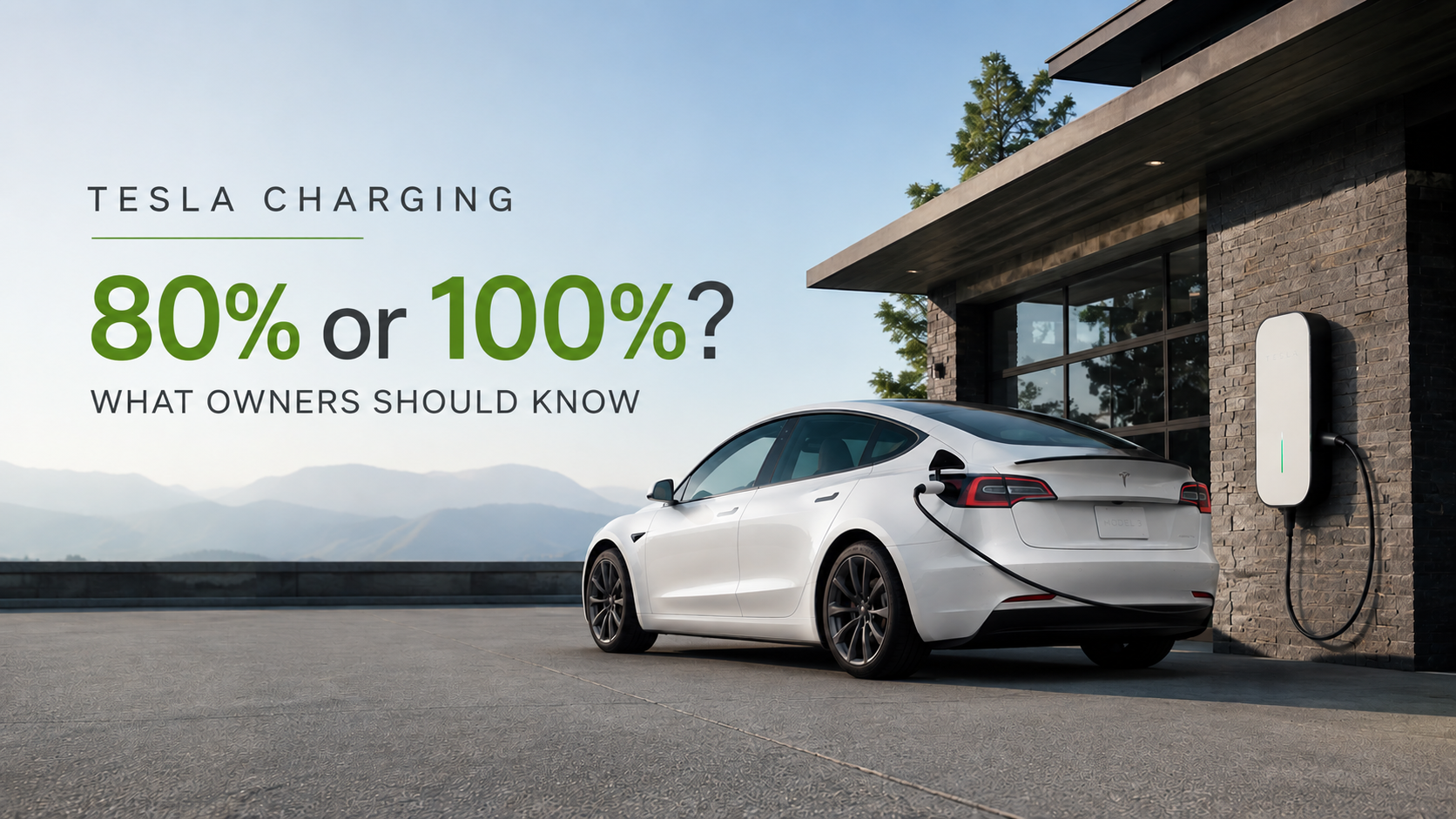
For many Tesla owners, the simple answer is 80% for everyday driving and 100% when you need the extra range. But there is an important exception: Tesla vehicles equipped with LFP (Lithium Iron Phosphate) batteries have different charging guidance.
Understanding your Tesla’s battery chemistry can help you choose the appropriate Tesla charging limit for your daily routine.
Here’s what Tesla owners should know about charging to 80% versus 100%, when a full charge makes sense, and how to develop better charging habits.
What’s Happening?
Not every Tesla battery should be treated exactly the same.
According to the information provided for this guide, many Tesla models using Nickel Manganese Cobalt (NMC) battery cells are best kept around an 80% charge limit for daily driving. Charging to 100% can then be reserved for situations where additional range is actually needed, such as a long road trip.
Tesla vehicles equipped with LFP batteries follow different guidance. These batteries benefit from being charged to 100% regularly, with the supplied information recommending a full charge once a week to help the vehicle accurately measure its remaining range.
That means there isn’t one universal charging percentage that is right for every Tesla.
The basic rule
| Situation | Suggested charge level |
|---|---|
| Daily driving with an NMC battery | 80% |
| Long trip requiring extra range | 100% |
| LFP battery | 100% regularly, according to the supplied guidance |
| Vehicle sitting unused for extended periods | Avoid leaving it at 100% |
The most important first step is determining which battery chemistry your particular Tesla uses.
Why It Matters
Your Tesla’s battery is one of the vehicle’s most important and expensive components. How you charge it is therefore worth paying attention to.
For daily driving, an 80% charging limit can help reduce the amount of time the battery spends at its maximum state of charge. The supplied information associates this practice with reducing battery stress and limiting long-term capacity loss for NMC batteries.
At the same time, charging to 100% isn’t something Tesla owners need to fear. A full charge can be useful when you actually need the additional driving range.
The key is how and when you use 100%.
For example, charging to 100% immediately before a long trip is different from charging to 100% and leaving the vehicle parked for several days.
What Tesla Drivers Should Know
1. 80% Is the Daily Target for NMC Batteries
For Tesla vehicles using NMC battery cells, the supplied guidance recommends an 80% charging limit for normal daily driving.
If you typically drive only a portion of your Tesla’s available range each day, there may be little reason to charge all the way to 100%.
An 80% limit also leaves additional battery capacity available for unexpected driving needs.
2. LFP Batteries Are Different
Tesla owners with an LFP battery should pay particular attention to their vehicle’s charging guidance.
LFP stands for Lithium Iron Phosphate, a different battery chemistry from NMC.
According to the supplied information, LFP-equipped Tesla vehicles should receive a 100% charge regularly—once a week—to help the vehicle accurately measure remaining range.
Because battery chemistry can vary between Tesla models and configurations, don’t assume that your car follows the same charging recommendation as another Tesla.
3. Check Your Specific Tesla
One of the most important pieces of advice is also one of the simplest:
Check which battery chemistry your Tesla uses.
The supplied source recommends checking Tesla’s support guidance or your Tesla app settings to determine the appropriate charging information for your vehicle.
This is particularly important if you’re comparing charging habits with another Tesla owner.
Your neighbor’s 100% charging routine might be appropriate for their vehicle but not necessarily yours.
4. 100% Makes Sense Before a Long Trip
If you’re heading out on a road trip and need maximum range, charging to 100% can be useful.
The supplied guidance recommends setting the charge limit to 100% right before the trip, rather than charging to full and leaving the vehicle parked at maximum capacity for a long period.
This gives you the additional range when you actually need it.
5. Don’t Leave the Battery at 100% for Long Periods
A full battery is useful when you’re about to drive.
It’s less useful when your Tesla is sitting in the driveway.
The supplied information recommends minimizing the amount of time the vehicle remains at 100% and starting your trip soon after charging is complete.
That makes a simple charging schedule useful: finish charging close to departure time when you need 100%.
How to Set Up a Better Charging Routine
Your charging routine doesn’t need to be complicated.
For an NMC Tesla used for daily driving:
- Plug the vehicle in when convenient.
- Set the charging limit to around 80%.
- Allow the vehicle to charge normally.
- Increase the limit when you need additional range.
- For a long trip, charge to 100% shortly before departure.
For an LFP Tesla:
- Check Tesla’s guidance for your specific vehicle.
- Use the recommended regular charging routine.
- According to the supplied information, charge to 100% once a week.
- Avoid leaving the vehicle at 100% unnecessarily for extended periods.
If you’re uncertain about your battery chemistry, check Tesla’s official support information rather than relying solely on advice from another Tesla owner.
Pros and Cons
Charging to 80%
Pros:
- Appropriate for daily driving with NMC batteries according to the supplied guidance.
- Reduces the amount of time an NMC battery spends at maximum charge.
- Leaves additional room for unexpected driving needs.
- Can be a simple everyday charging routine.
Cons:
- Provides less available range than a 100% charge.
- May require a higher charging limit before longer trips.
Charging to 100%
Pros:
- Provides maximum available charge for a trip.
- Useful when additional driving range is needed.
- Regular full charging is part of the supplied guidance for LFP batteries.
Cons:
- For NMC batteries, it should generally not be the everyday charging target according to the supplied information.
- The supplied guidance recommends minimizing the time an NMC Tesla remains at 100%.
Practical Tips for Tesla Battery Charging
1. Match the charging limit to your battery
Don’t copy another Tesla owner’s charging percentage without knowing whether your vehicles use the same battery chemistry.
2. Use 80% for normal NMC daily driving
If your Tesla uses an NMC battery and 80% provides enough range for your normal routine, use that as your everyday charging limit.
3. Save 100% for when you need it
Planning a long road trip? Increase the limit and charge to 100% shortly before departure.
4. Follow LFP charging guidance
If your Tesla uses an LFP battery, follow the vehicle-specific guidance for regular full charging.
5. Avoid leaving the battery at extremes unnecessarily
The supplied information recommends avoiding situations where the battery remains near 0% or at 100% for many days.
6. Plug in regularly
The supplied guidance recommends keeping the vehicle plugged in at home when it isn’t being used so the car can manage its temperature and battery state appropriately.
A Little EV Humor
Tesla owners have discovered that range anxiety has a surprisingly simple solution:
Charge the car.
Then comes the next question:
“Should I charge to 80%?”
“90%?”
“100%?”
Suddenly, checking your battery percentage feels like a small science project. 😂
FAQ
Should I charge my Tesla to 80% every day?
For Tesla vehicles with NMC batteries, the supplied guidance recommends an 80% charging limit for daily driving.
Should I charge my Tesla to 100%?
A 100% charge can make sense when you need additional range for a long trip. The supplied guidance recommends charging to 100% shortly before departure rather than leaving the vehicle at full charge for an extended period.
What if my Tesla has an LFP battery?
According to the supplied information, LFP-equipped Tesla vehicles should be charged to 100% regularly, once a week, to help the vehicle accurately measure remaining range.
How do I know which battery my Tesla has?
The supplied guidance recommends checking Tesla’s support information or your vehicle’s app/settings to determine which battery chemistry your specific Tesla uses.
Is charging to 100% bad for a Tesla?
The supplied information does not say that a 100% charge should never be used. Instead, charging to 100% is recommended when extra range is needed, while avoiding leaving the vehicle at 100% for long periods.
Should I let my Tesla battery get close to 0%?
The supplied guidance recommends avoiding letting the battery drop near 0% and avoiding leaving it at extreme charge levels for extended periods.
Conclusion
So, should you charge your Tesla to 80% or 100%?
For many Tesla owners with NMC batteries, 80% is the recommended everyday charging limit, while 100% is useful when you need the extra range for a long trip. For Tesla vehicles with LFP batteries, regular 100% charging is part of the supplied guidance.
The most important takeaway is that battery chemistry matters. Before changing your Tesla charging routine based on advice from another owner, check what battery your specific vehicle uses and follow the applicable Tesla guidance.
For everyday driving, the goal isn’t to keep your battery as full as possible. It’s to have enough energy for your needs while using an appropriate charging routine.





Walmart Hits 100 EV Fast-Charging Sites
SpaceX’s $3.5 Trillion Revenue Vision